 norsk språk
 English
 français
 Deutsch
 italiano
 español
 português
 Nederlands
 Türkçe
 Tiếng việt
 Indonesia
 svenska


A golf umbrella is the most visible branded object on a course. It is also the category where B2B buyers make the most expensive specification mistakes, because the numbers on a product page — 54 inch, 62 inch, 8 ribs, 16 ribs, vented, double canopy — are not measured or named consistently between suppliers.
This guide explains what each number actually controls, how canopy construction changes behaviour in wind, and which specification fits which buyer: golf clubs and resorts, corporate gifting, promotional distributors, or retail. It is written from the factory side of the table, so it focuses on the decisions that change cost and durability rather than catalogue adjectives.
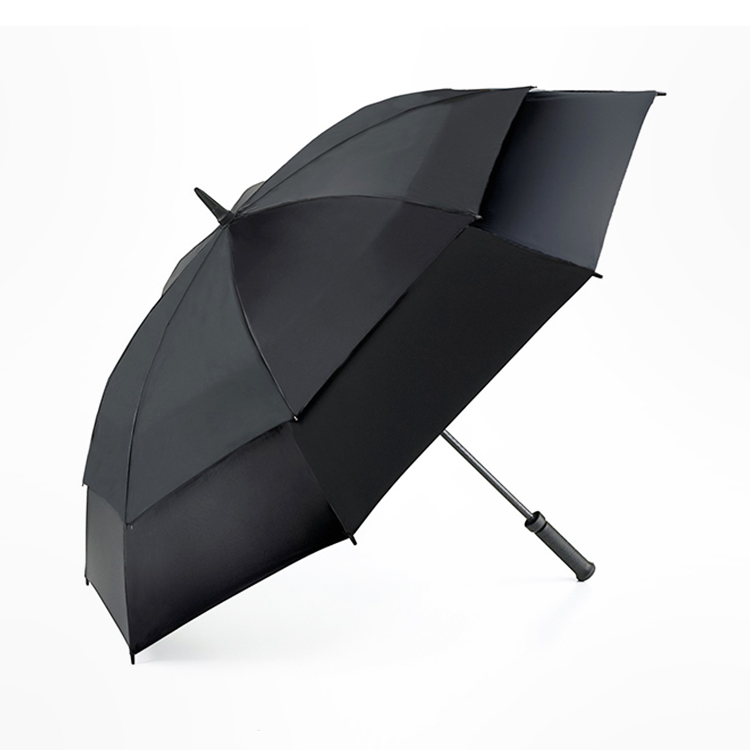
Double layer vented canopy on an 8-rib fibreglass frame — the construction most wind complaints trace back to.
The inch figure refers to the size of the open canopy, but suppliers quote it in two different ways: as the open diameter across the canopy, or as the arc length measured along the curve of a panel from tip to tip. Because an umbrella canopy is curved, the arc number is larger than the straight-line diameter for the same umbrella.
That is why a "60 inch" umbrella from one factory can feel identical to a "54 inch" umbrella from another. It is also why the most reliable specification is not the inch figure at all, but the rib length and rib count — for example, a 30 inch rib on an 8-rib frame — because those are physical dimensions that cannot be redefined by marketing.
Practical rule: when comparing quotes, ask for rib length in inches or centimetres plus rib count, and confirm whether the headline size is open diameter or arc. Two suppliers quoting "58 inch" against different conventions are not quoting the same product.
Large enough to cover shoulders and a laptop bag, small enough that a guest will actually carry it. This is the size most hotels, banks and corporate gift programmes order, and the size of our 54 inch double layer vented canopy golf umbrella. A 30 inch by 8-rib frame keeps the weight reasonable while the two-layer canopy handles gusty street corners.
The extra panel width covers a golf bag or two people walking together. Clubs and resorts tend to specify this range for caddie and tournament umbrellas. The trade-off is weight and folded length — both climb with canopy size, and a heavier umbrella is the one that stays in the car.
Very large canopies are used for tournament branding, outdoor hospitality terraces and photo opportunities. They need a stronger frame and more ribs, and they are rarely carried for long. Order these for visibility, not for daily use.
These three terms are often used interchangeably, and they should not be. They describe different construction, with different failure modes.
| Construction | How it is built | Behaviour in wind | Best for |
|---|---|---|---|
| Single canopy | One layer of fabric over the ribs | Air has nowhere to go; panels load up and can invert | Indoor, low wind, tight budget |
| Vented canopy | Slits or open vents between canopy sections | Gusts pass through the vents, reducing lift and inversion | Golf, coastal cities, open ground |
| Double canopy | Two fabric layers; the upper layer shelters the lower | Adds stiffness and a second barrier; vents between layers release pressure | Premium retail, brand programmes that must survive a season |
A well-made umbrella can be both vented and double-layered, which is what most serious golf programmes end up specifying. The two features solve different problems: the double layer resists water penetration and stiffens the canopy, while the vent prevents the whole structure from becoming a sail.
Buyers tend to shop rib count because it is easy to compare. But rib count only distributes load; venting removes load. An 8-rib vented umbrella often outperforms a 16-rib single-canopy umbrella in a gusty car park, because the vented one is never holding the full pressure of the wind.
Where rib count does matter is in the shape of the canopy. More ribs produce a rounder dome with shorter fabric spans between ribs, so panels flap less and the canopy holds its shape in photographs and on a shop floor. That is why 16-rib models look and photograph better than 8-rib models, even when both are structurally adequate. Our 16 rib long handle golf umbrella, for example, uses a polyester canopy on a 16-rib steel frame at roughly 500 g — a retail-facing specification chosen for silhouette as much as for strength.
The frame is what fails first. Three specifications cover most of the market:
One detail worth asking about: the joint between rib and stretcher. Riveted joints with metal reinforcement last longer than stitched-only connections, and this is invisible in a product photo. On a sample, open and close the umbrella twenty times and watch those joints.
The "T" in 190T pongee is thread count per square inch. Higher is denser: a denser weave blocks water better, prints more sharply and feels smoother in the hand. Pongee is a fine, tightly woven polyester variant with a soft hand feel; plain polyester is cheaper and slightly coarser but perfectly serviceable for promotional work.
For a golf umbrella that will be used in real weather, 190T pongee with a water-repellent finish is the sensible floor. Below that, water starts to wick through the weave in sustained rain — not immediately, but by the second hole.
The handle is the only part the user touches, so it is where a modest upgrade is felt most. Moulded plastic is the default. EVA foam is warmer in cold weather and gives a better grip when wet, which is why it appears on golf-specific models. Wooden handles — straight, or curved hook — read as premium and suit hotel and corporate programmes; they are also hand-fitted, so they carry a labour cost as well as a material cost.
If your logo is going on the handle rather than the canopy, confirm the marking method early. Pad printing on a curved plastic handle and laser engraving on wood are different processes with different setup and different minimums.
Golf umbrellas are usually specified as auto open or auto open with manual close. The distinction sounds trivial until you handle a few hundred units:
Two checks catch most mechanism problems at the sample stage. First, open and close the umbrella at least twenty times and listen for the runner sticking. Second, look at the spring housing: a covered or reinforced housing survives transit and daily use far better than an exposed spring sitting next to the shaft.
If your programme involves a warranty, ask what it covers. Ours is a two-year quality guarantee on the umbrella, and the mechanism is the component that generates most claims — which is why it is worth specifying properly rather than accepting whichever runner the factory has in stock.
A golf canopy is eight or sixteen curved panels sewn together. A design that looks continuous in a flat file will break at every seam. There are two workable approaches:
Whatever the method, ask for a printed proof on the actual fabric before production. Colour on fabric shifts against colour on paper, and dark canopies absorb ink differently from light ones.
With those eleven lines, a factory can quote a comparable specification instead of a guess. Without them, you will receive numbers that cannot be compared, and the cheapest one will not be the best value.
It is manageable but noticeable. A canopy that size covers a golf bag or two people, and the frame needed to support it adds weight. For commuting, 54 to 58 inches is the practical range; for tournament branding and hospitality, go larger.
They distribute load more evenly and hold a rounder canopy shape, but they do not stop wind from lifting the canopy. Venting does that. The strongest practical combination is a moderate rib count on a fibreglass frame with a vented double canopy.
In practice it means the frame recovers its shape after inversion rather than permanently bending. It is a construction claim — fibreglass ribs, flexible joints, vented canopy — not a wind speed rating. Be cautious with suppliers who quote a specific wind speed without a test standard behind it.
Yes, with dye sublimation on a full canopy. Screen printing and heat transfer are applied panel by panel, so artwork must be designed around the seams. Tell your supplier which approach you expect before artwork is finalised.
100 pieces per design for our range. Smaller runs are possible on stock colours with simple printing, but setup costs dominate the unit price at that scale.
Weight follows the frame and canopy. A 16-rib steel-framed model with a polyester canopy is around 500 g; a 10-rib aluminium reverse-folding model is around 405 g. If weight is a retail requirement, specify it as a target in grams, not as an adjective.
If you are choosing between sizes and canopy types for a specific programme, send us the market, the quantity and one or two reference umbrellas you like. We will come back with a specification that matches the use case rather than the biggest number on the page. The full range is on our golf and walking umbrella collection.



Adresse : Huli High-tech Park, Huli District, Xiamen, Fujian, China
Vennligst les videre, hold deg oppdatert, abonner, og vi ønsker deg velkommen til å fortelle oss hva du synes.
Opphavsrett © Susinoumbrella.com - DYY LIMITED Alle rettigheter forbeholdt.
Nettstedkart
| Blogg
| Xml
| Personvernerklæring
 Nettverksstøtte
